
There are no upcoming events.
Meeting/Event Information
The anticipate 2026 meeting schedule for the Northeast Section is presented below. As dates and times may change, please check back for updates and specific meeting announcements. Meetings are open to all members—hope to see you there!
2026 Executive Committee Meeting Schedule: typically the first Monday of the month, adjusted for holidays.
• ExCom Monday Jan 5
• ExCom Monday March 2
• Spring Meeting Wednesday April 15
• ExCom Monday May 4
• ExCom Monday July 6
• ExCom Monday September 14
• ExCom Monday October 5
• Fall Meeting early October
• ExCom Monday Dec 7
Executive Committee Meetings are typically held from 4:00 to 5:30 pm via Zoom. Spring and Fall Membership Meetings are often in-person events with exact dates, times, and locations TBD.
3/25 NE-AIPG Webinar - Posillico Wash Plant
March 25, 2025
6:00 PM to 7:00 PM
Add to Calendar
Webinar - Online - Zoom
Webinar: Tuesday, March 25th, 2025
Registration is Closed.
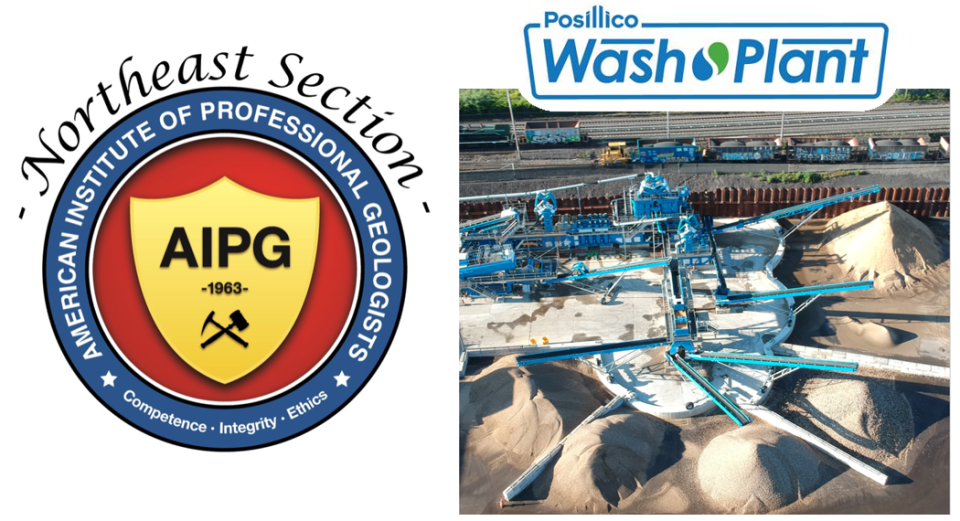
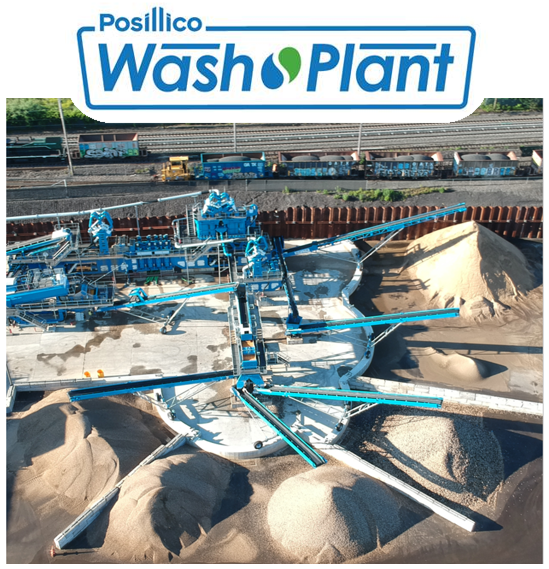
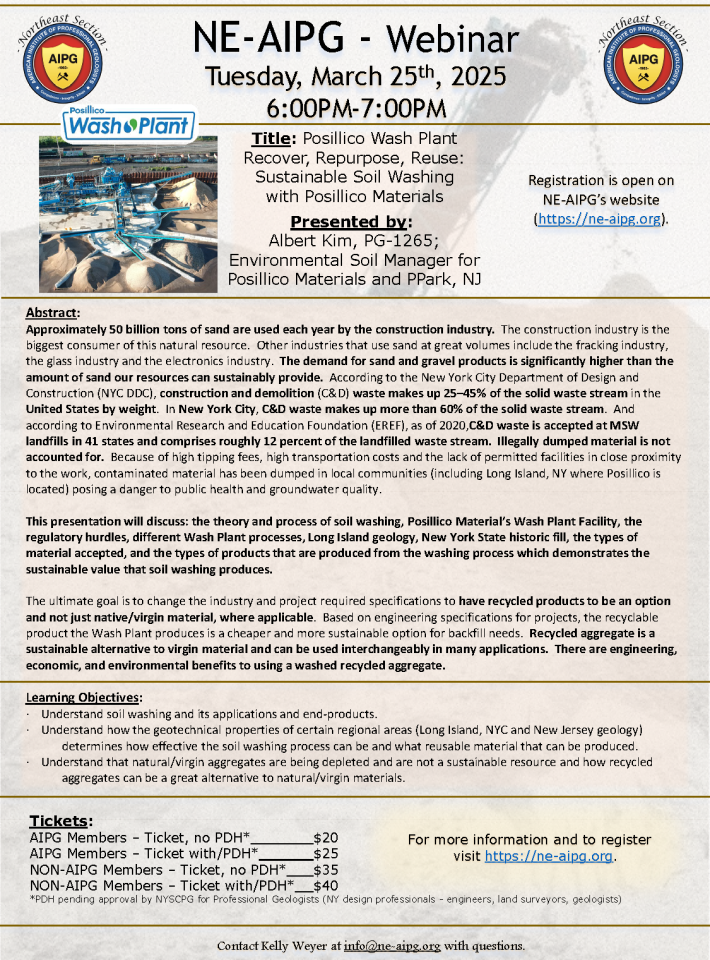
Title: Posillico Wash Plant Recover, Repurpose, Reuse: Sustainable Soil Washing with Posillico Materials
Speaker Biography:
Licensed Professional Geologist (New York No.: 001265) and experienced Environmental Professional with 10 + years of experience in subsurface/remedial investigations, chemical data review and analysis, solid waste management, state and federal environmental codes, rules and regulations, and environment, health, and safety (EHS). Currently serving as Environmental Soil Manager for Posillico Materials and PPark, NJ. Offers dependability, commitment, excellent communication and interpersonal skills and professional/technical knowledge. BA Geology (SUNY Geneseo, 2012), MS Environmental Studies (Adelphi University, 2018).
Abstract for the Talk:
Approximately 50 billion tons of sand are used each year by the construction industry. The construction industry is the biggest consumer of this natural resource. Other industries that use sand at great volumes include the fracking industry, the glass industry and the electronics industry. The demand for sand and gravel products is significantly higher than the amount of sand our resources can sustainably provide. According to the New York City Department of Design and Construction (NYC DDC), construction and demolition (C&D) waste makes up 25–45% of the solid waste stream in the United States by weight. In New York City, C&D waste makes up more than 60% of the solid waste stream. And according to Environmental Research and Education Foundation (EREF), as of 2020,C&D waste is accepted at MSW landfills in 41 states and comprises roughly 12 percent of the landfilled waste stream. Illegally dumped material is not accounted for. Because of high tipping fees, high transportation costs and the lack of permitted facilities in close proximity to the work, contaminated material has been dumped in local communities (including Long Island, NY where Posillico is located) posing a danger to public health and groundwater quality.
This presentation will discuss: the theory and process of soil washing, Posillico Material’s Wash Plant Facility, the regulatory hurdles, different Wash Plant processes, Long Island geology, New York State historic fill, the types of material accepted, and the types of products that are produced from the washing process which demonstrates the sustainable value that soil washing produces.
The ultimate goal is to change the industry and project required specifications to have recycled products to be an option and not just native/virgin material, where applicable. Based on engineering specifications for projects, the recyclable product the Wash Plant produces is a cheaper and more sustainable option for backfill needs. Recycled aggregate is a sustainable alternative to virgin material and can be used interchangeably in many applications. There are engineering, economic, and environmental benefits to using a washed recycled aggregate.
Learning Objectives:
· Understand soil washing and its applications and end-products.
· Understand how the geotechnical properties of certain regional areas (Long Island, NYC and New Jersey geology) determines how effective the soil washing process can be and what reusable material that can be produced.
· Understand that natural/virgin aggregates are being depleted and are not a sustainable resource and how recycled aggregates can be a great alternative to natural/virgin materials.
Click Flyer to enlarge
Tickets
$25.00 Member Registration w/1PDH
$20.00 Member Registration no PDH
$40.00 Non-Member Registration w/1PDH
$35.00 Non-Member Registration no PDH
