
NE-AIPG Fall Meeting
October 02, 2026
Add to Calendar
Field Trip: Little Falls and Fonda, NY; Dinner: Rustic Loft Pub and Grill, 4740 NY-30, Amsterdam, NY 12010
Herkimer area, NY
Field Trip and Dinner Meeting - Herkimer Diamonds. Field trip focus is on high accuracy mapping, structural Geology and stratigraphy of the Little Falls Dolostone and quartz bearing zones. Evening presentation expands on field trip content.
Meeting/Event Information
The anticipate 2026 meeting schedule for the Northeast Section is presented below. As dates and times may change, please check back for updates and specific meeting announcements. Meetings are open to all members—hope to see you there!
2026 Executive Committee Meeting Schedule: typically the first Monday of the month, adjusted for holidays.
• ExCom Monday Jan 5
• ExCom Monday March 2
• Spring Meeting Wednesday April 15
• ExCom Monday May 4
• ExCom Monday July 6
• ExCom Monday September 14
• ExCom Monday October 5
• Fall Meeting early October
• ExCom Monday Dec 7
Executive Committee Meetings are typically held from 4:00 to 5:30 pm via Zoom. Spring and Fall Membership Meetings are often in-person events with exact dates, times, and locations TBD.
Lunch-Time Webinar - Wednesday, February 11, 2026
February 11, 2026
12:00 PM to 1:00 PM
Add to Calendar
Lunch-Time Webinar - Zoom; Registration open now!
Registration is now open!
Lunch-Time Webinar - Wednesday, February 11, 2026 12pm-1pm (EST)
Approved for 1 PDH*
Talk Title:
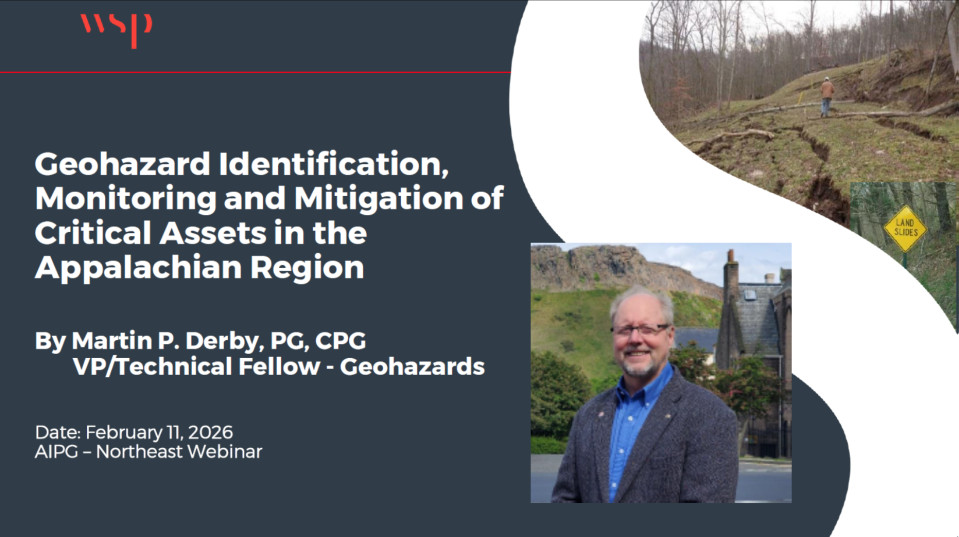
"Geohazard Identification, Monitoring and Mitigation of Critical Assets in the Appalachian Region”
Presented by:
Martin P. Derby, P.G., CPG
WSP Vice President – O&G Programs Technical Fellow - Geohazards
*Approved for 1 Professional Development Hours (PDHs) by NYSCPG for PGs and other Design Professionals (LA, LS, PE, RA) as defined in section 7201 of the Education Law.
OBJECTIVES OF THIS PRESENTATION
• To introduce and define Geohazards and how they effect our critical assets, including the
what, who, why and how of geohazards
• To review the approach to assessing geohazards
• To provide an overview of pipeline monitoring methods
• To review some basic slope mitigation measures for protecting the critical assets
Abstract:
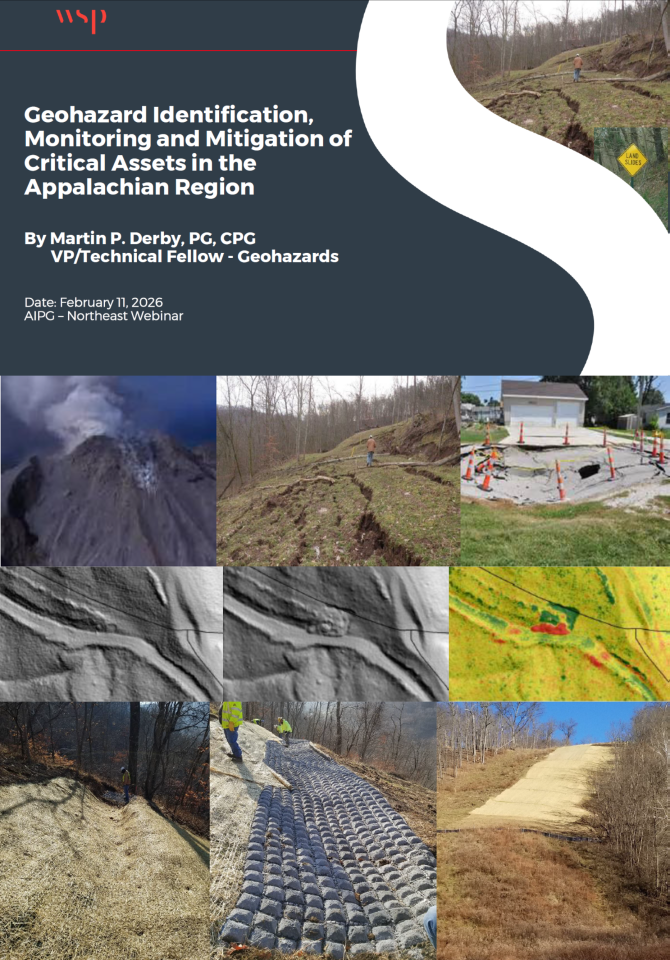
Geohazards have the potential to adversely impact infrastructure in the Appalachian region, including pipelines. Unstable slopes, seismic, subsidence, and hydrotechnical (water erosion) hazards are just a few types of geohazards that will be discussed in detail. Performing geohazard assessments along pipeline corridors assists owners and operators in determining if a natural hazard may impact their assets. A phased approach can be used to identify, characterize, and ultimately mitigate/monitor potential geohazards. The phased approach begins with a regional-scale desktop assessment (Phase I) to identify, initially characterize, and qualitatively classify (e.g., low, moderate, high hazards) geohazards. Following the desktop assessment, a non-intrusive ground reconnaissance (Phase II) can be completed at targeted sites that warrant additional assessment. Following the ground reconnaissance, subsurface investigations (Phase III) such as drilling, test pitting, or geophysical surveys can be carried out at specific sites of concern to further characterize hazards. The Phase III program includes the collection of sufficient data to plan for and design site specific mitigation and/or monitoring, if deemed necessary. In-situ pipeline (e.g., strain gages) and slope monitoring (e.g., inclinometers, tilt meters, etc.) methods will be discussed, as well as other advanced monitoring methods, such as InSAR (satellite), LiDAR (airborne), and ground based InSAR. If a geohazard assessment and or monitoring deem that a mitigation is required, then a detailed design would need to be performed. Several slope mitigation case studies will be presented.
Speaker Bio:
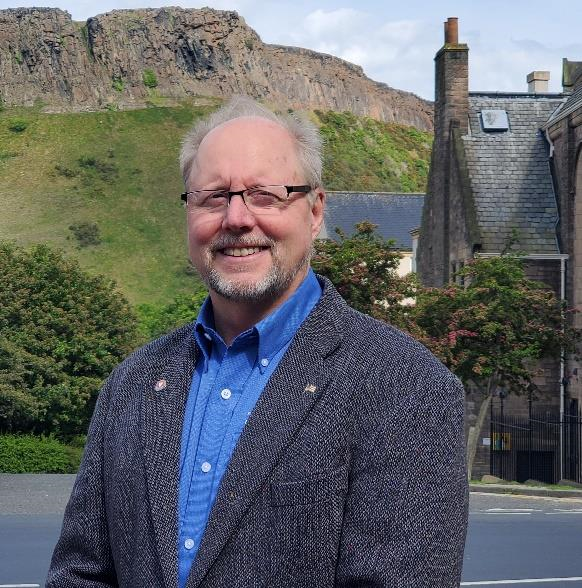
Martin Derby, VP of O&G Client Programs/Technical Fellow - Geohazards at WSP and has over 40 years of experience in subsurface exploration, monitoring/pipeline subsidence, slope monitoring, geohazard analysis & geotechnical design for soil stabilization. Martin received his civil engineering technology degree from Hudson Valley Community College, his bachelor’s in geology from the University at Buffalo, and his master’s in geoscience from Montclair State University. Martin has co-authored eight published papers on geohazard identification, monitoring and slope mitigation and is a professional licensed geologist in NY, PA, Ill, and AK. Martin leads the WSP US Strategy House program for Geohazards which includes the development of an internal network of geohazard professionals and client growth and expansion in the oil& gas, transportation, and mining sectors. International speaker on the impacts of geohazards on pipeline infrastructure/monitoring techniques with countries that include Argentina (Buenos Aires); Canada (Calgary); Italy (University of Rome, Poppi and Rome); Peru (Lima); Scotland (Edinburgh), Spain (Barcelona and Madrid), and various cities in the United States.
Tickets
$25.00 Member Registration w/1PDH
$20.00 Member Registration no PDH
$40.00 Non-Member Registration w/1PDH
$35.00 Non-Member Registration no PDH
